

Ten years ago, half (well, at least 48%) of Britain woke up wondering how on earth the Brexit referendum had slipped through their fingers.
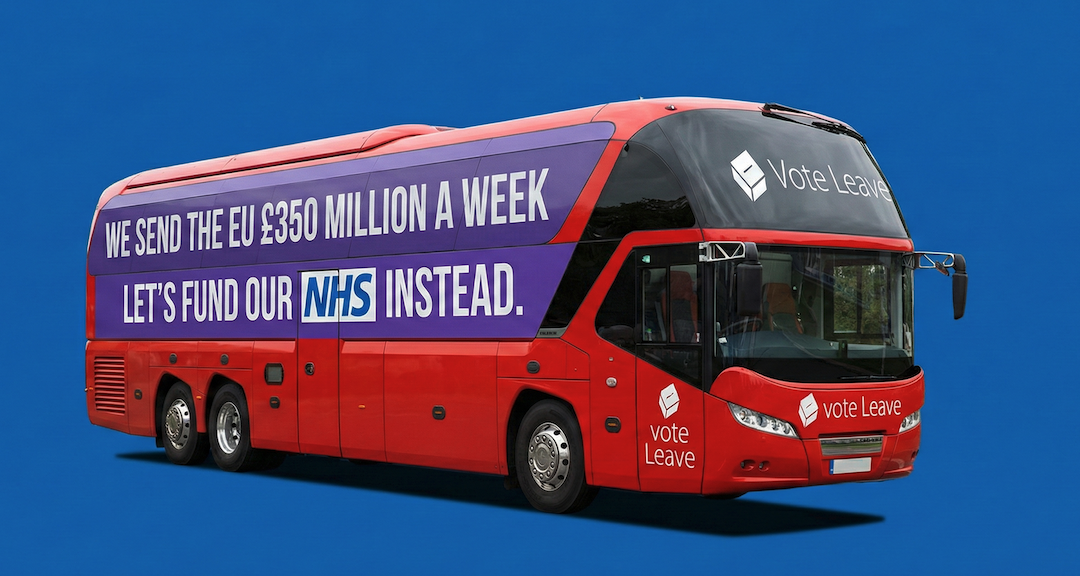
Pundits had the numbers. Economists had the models. Government departments had the forecasts. And yet, a big red bus with a slogan on the side beat the lot of them.
For comms experts, Brexit is more than just political history. It’s an awkward reminder that facts alone rarely win an argument.
No one makes up their mind because of a spreadsheet. Whether they admit it or not, almost everyone always goes with their gut.
So, a decade on, here’s the uncomfortable question: Have professional communicators learned the Brexit lesson yet?
Why facts never stood a chance
There’s a biological reason the bus beat the briefing paper. It’s not that voters are stupid. It’s just that our brains are busy.
Neuroscientists often describe the brain as three systems stacked on top of each other. Less as layers of intelligence than a queue, with logic right at the back.
First comes the primal, or lizard brain. It’s our autopilot that makes decisions in a split second, working out whether something is worthy of our attention.
It can be triggered by movement, bright colours or familiar faces. The lizard brain is our evolutionary protection against threats.
Fight or flight is instinctual, not logical.
That’s why a shouty message on the side of a red bus touring the country beats a downloadable PDF every time. It screams: “Look at me”.
There’s no time to think.
Then comes the emotional brain
Once you’ve grabbed someone’s attention, the next system fires. This is where we decide: Do I care?
Powerful triggers here are emotions. That could be identity, belonging, pride, fear, hope or anger. (Just ask the algorithms. They know),
“Take back control” wasn’t a policy position. It was therapy for a nation. The slogan gave people agency, made them the hero of the story and promised something better.
Compare that to Mark Carney (then at the Bank of England): “A vote to leave could have material economic effects on growth and inflation.”
It’s technically correct, but emotionally dead. One instantly tugs at your heart, the other needs a calculator and forward planning. There really is no contest.

Finally (way back in the rearview mirror) comes logic
The rational part of our brain is the slow bit. Switching from autopilot to manual decision making requires time and a lot of energy.
It’s almost never where we make a decision. That’s signed and sealed in a split second, so our logical brain’s job is to post-rationalise the choice we’ve already made.
The white papers, footnotes and forecasts are still essential. But they work best when justifying an argument that you’ve already won.
For a message to work, you need all three elements in the right order:
- Grab the reader’s attention (primal)
- Trigger an emotion (limbic)
- Then provide proof (rational)
Brexit wasn’t won because one side had better data. It was because one side understood winning campaigns. The rest of us brought spreadsheets to a feelings fight.

And finally, some good news
Great campaigning isn’t magic, it’s craft. It demands the same skills journalists, campaigners, and copywriters have always used: find the human angle, sharpen the promise, cut the jargon.
This is exactly how we’ve helped teams turn dense policy and complex research into stories people engage with.
We recently analysed 20+ global campaigns, all with broadly the same brief: How can behaviour-change communications reduce violence against women?
Unsurprisingly, the most successful blended attention-grabbing creatives and practical actions. They combined rational and emotional arguments.
Previously, we’ve helped the EU Agency for Fundamental Rights rebuild its approach to tackling online disinformation, so messages lead with people and values, not process.
And when we advise companies on their crisis comms responses, we’re always asking the annoying question: How would your proposed action make your key stakeholders feel?
For our clients’ challenges ranging from reducing retail loss or piracy, through to improving gender equality, we’ve seen the same thing again and again. Stories move people while spreadsheets provide the support.
Never the other way round.
If you want to produce a campaign that wins hearts and minds, we're here for you. Get in touch, and we'll help reach the people that matter.