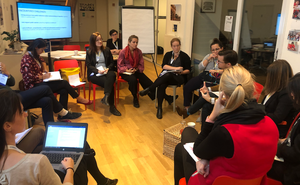


I re-watched Tracey Emin's Why I Never Became a Dancer at Tate Modern at the weekend.
It's the first of hundreds of incredibly personal stories in her brilliant exhibition. This one about a handful of boys who decided to label a teenage girl ('Slag, Slag, Slag'), and repeated it until their peers believed them.
It's also a piece about misinformation. And power. Not the geopolitical kind. The local, personal, vindictive male kind. About how lies spread.
Which led naturally into the Manosphere.
Say something outrageous, go viral, convert the attention into a desirable lifestyle funded by the Ponzi schemes of access, course sales and crypto promotion. Violence for views. Degradation for engagement.
(Unless your mum is there to put you in your place, as Louis Theroux brilliantly observed in his Netflix documentary)

Misinformation is now a big part of the machinery to generate 'clout'. And income.
Just look at the rise of Polymarket.
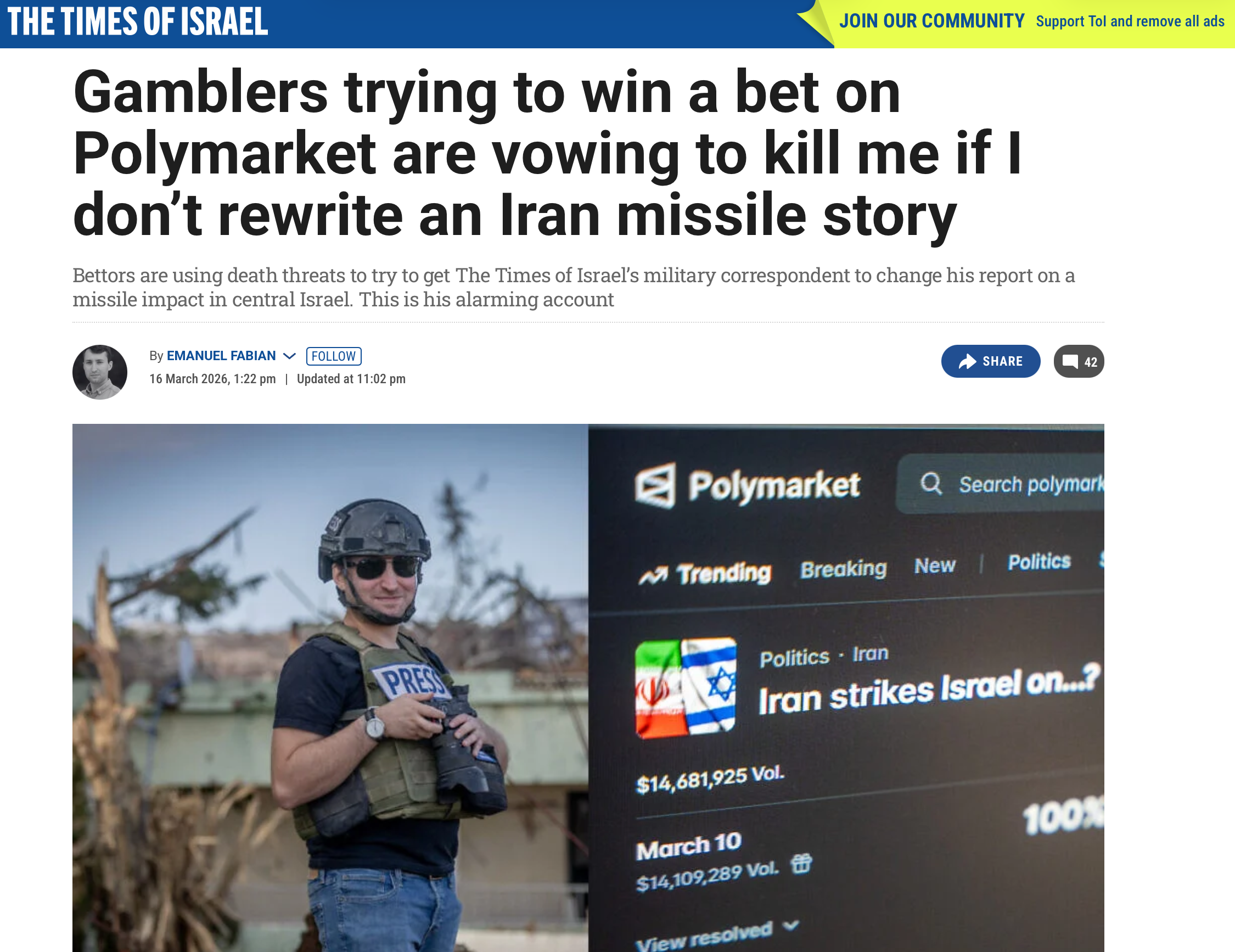
This week, Emanuel Fabian, a military correspondent for the Times of Israel, reported that he has been bribed/harassed/threatened to change an article he wrote because more than $14 million had been wagered on Polymarket, a new prediction market, on whether Iran would strike Israel on 10 March. Fabian's factual report meant certain gamblers would lose. He wasn't popular.
After you make us lose $900,000, we will invest no less than that to finish you.
Fabian refused to change a word. He stuck to 'information' not 'misinformation'.
But what if he had? And how would we ever find out? Yes, the US is trying to legislate against prediction market bets on war and terrorism but the words 'horse' and 'stable door' spring to mind.
Hello Misinformation, my old friend...
The old playbook for dealing with misinformation was straightforward. Work out who benefits. Trace the source. Show the world proof that they're not telling the truth. (On which note, the recent Blair documentary was also very good about those WMDs)
At the heart of this old-school model is regulation. Regulators are always playing catch-up, but it sort of worked. They could keep pace, just about, because the channels were slow.
But that world is gone.
Yes: US lawmakers have already introduced the "Bets Off Act" to ban prediction market bets on war and terrorism.
But also yes: An Israeli military reservist and a civilian were indicted last month for using classified information to place bets on Polymarket ahead of military operations.
The incentive machine
Closer to home, parents and head teachers have recently had to navigate the "Red vs Blue school wars."
Starting in mid-February, AI-generated posters appeared on TikTok and Snapchat dividing London schools into rival colour-coded teams and calling for mass after-school fights.

Over fifty schools across twelve boroughs were named. Hundreds of Met officers were deployed. Schools cancelled clubs and detentions. Heads increased security patrols. Parents panicked. Children were afraid to walk home.
But the threat was largely vapour. LondonCentric sent a reporter to Hackney and found bored teenagers and heavy policing. The Met confirmed no violent incidents in the capital. BBC News called it a 'phantom trend.'
But in Bristol, a teenage girl was followed by a group of 25 youths, and beaten badly enough to be hospitalised. Five arrests followed.
So were the 'red v blue school wars' real? Or not?
Yes.
To both questions.
And therein lies the problem.
Teachers and parents had to assume it was real. Even though much of it was fabricated and overblown.
And that's the challenge we now face when dealing with disinformation and misinformation. And as we prepare issues and crisis comms training.
The cost is real. The old tools are not enough.
In each case, the pattern is the same. Someone creates or spreads false information because there's something to gain: subscribers, money, attention, or just chaos. The platforms amplify it (usually taking no responsibility at all).
The costs are absorbed elsewhere.
"Follow the money" still matters. But it's no longer sufficient. By the time you've traced the source and triggered a regulatory response, the damage is done.
The Polymarket threats happened in hours.
The school wars spread across the UK in less than a week.
The manosphere has been radicalising young men for years while regulators debated jurisdiction and action.
The world moves faster. The incentives are bigger. And AI-generated content means the barriers to entry have collapsed. You no longer need a printing press or a broadcast licence to reach millions.
You just need a phone and a nano banana.
So what replaces the old playbook?
Prevention is the answer.
Investment in the infrastructure that helps people (particularly young people) spot misinformation before it lands, not after.
Yes, amongst traditional media there is now significant investment in spotting misinformation and alerting people to it. But it's not a great business model.
Bellingcat, based in Amsterdam, has built a global network of open-source investigators who have identified war criminals, exposed state-backed disinformation campaigns, and trained thousands of journalists in verification techniques.
BBC Verify now has more than sixty journalists dedicated to fact-checking and countering disinformation in real time.
Full Fact catches fabricated news reports before they spread.
London Centric did the obvious thing no one else bothered with during the school wars: they went to Hackney and looked.
And ABC News in Australia recently did a fantastic piece about the amount of AI slop that's visible on Facebook.
This video they combined from posts on UK Diaries and Inside Australia is the same script, the same issues. But one's tailored for an angry British audience and one an angry Australian one. Terrifying. But true.
The bad news is that most of these organisations are chronically underfunded and take their 'public service' remit seriously.
Bellingcat relies on grants and workshop revenue.
Full Fact runs on donations.
The BBC and the New York Times can invest in verification because some people are prepared to pay for accuracy. But the audience for fact-checking will never match the audience for outrage. The commercials don't stack up.
The kids are alright
So what's the one thing that moves faster than money? The teenage brain.
Here's the thing about the school wars. The kids weren't fooled. The adults were.
As Lib Peck director of London's Violence Reduction Unit pointed out, the 'red v blue' school wars in London prompted a massive reaction from parents and authorities, but among the young people who were supposedly the target, there was almost none.
Kids have always been more media-savvy than their parents give them credit for.
We need to invest in it.
Whether it was Margate in the 1970s, or the manosphere in Miami in 2026, kids grow up in an information environment that would make their parents' generation weep. They can smell a fake. What they lack are structured tools to act on that instinct: to verify, to investigate, to push back.
When the social media channels fail in their duty to provide those tools, we need to find other ways kids can get their voices heard.
The Reuters Institute and Bellingcat's founder, Eliot Higgins, have argued for exactly this: teaching open-source investigation skills in schools and universities.
Not as a niche specialism, but as a basic civic competence. If anyone with a smartphone can publish, anyone should be able to verify. A pilot programme is already running at the University of Nottingham, with plans to extend into schools.
Of course some kids 'get it' straight away. But many don't. We need to do more to help those weighing up the 'red pill/blue pill' dilemma or struggling with body dysmorphia to source the facts.
This will involve a radical renovation of how we teach, as well as what we teach.
When everything online is a potential text book, critical thinking is more important than ever before.
What professional communicators should do
At Restless, we've built counter-disinformation frameworks for the EU's Fundamental Rights Agency and designed values-led narrative interventions for the CLAIM Alliance in Germany that measurably shifted attitudes in a polarised environment without triggering backlash.
We've developed digital strategies for regulators operating where a single poorly calibrated message can do more harm than the misinformation it was trying to counter.
The lesson from all of that work is the same one that emerges from every example above.
Reactive myth-busting doesn't work.
Repeating the lie to debunk it can reinforce it.
The organisations that get this right invest in structure: audience segmentation, combining facts and emotions, anti-misinformation frameworks which work, governance-aware approval processes, evaluation frameworks that distinguish between reach and actual attitudinal shift, and capacity building that equips teams to respond proportionately rather than panic.
And it starts by trying to find common ground.
Policymakers, Governments, Schools and media owners all have a big role to play. To educate young people. And their parents too.
Tracey Emin rewrote her own story by turning misinformation into art. Most of us don't have that option. But we can build systems that make lies more expensive to tell than the truth.
That's the new playbook. And we need it now.